
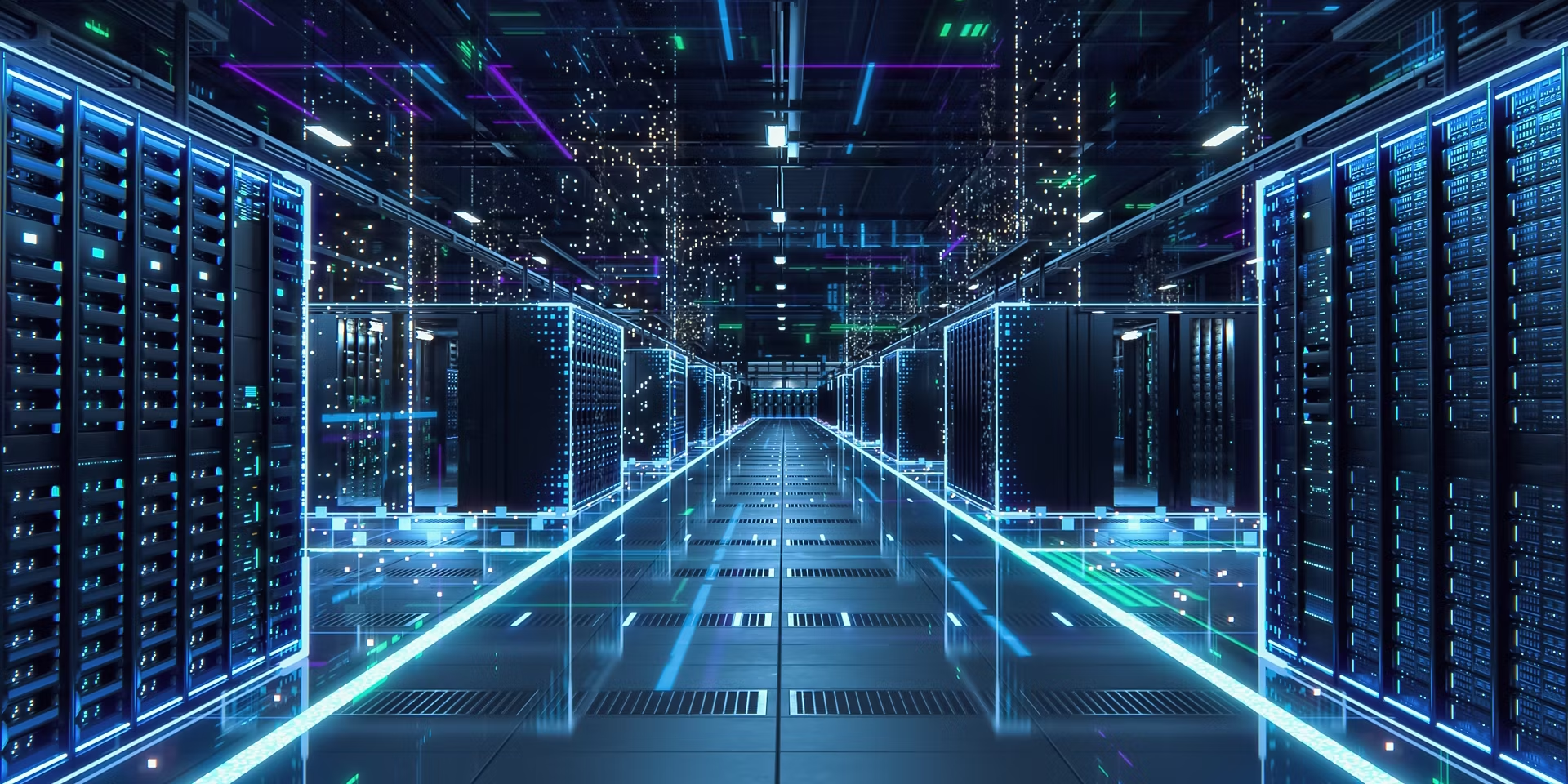
From Server Rooms to the Intelligent Core of the Digital World
Data centers, the unassuming warehouses of the digital age, have undergone a radical transformation. Their journey from simple computer rooms to the complex, intelligent, and sustainable nerve centers of our global economy mirrors the evolution of technology itself. As we stand on the brink of unprecedented technological advances, understanding this progression is key to anticipating the future of our connected world.
From Humble Beginnings: A Historical Perspective
The story of data centers begins in the mid-20th century with the era of mainframe computers. These colossal machines, like the iconic ENIAC, required meticulously controlled environments—cooled, clean rooms with raised floors for cabling and dedicated power supplies. These were the proto-data centers: singular, isolated temples to computation.
The client-server model of the 1980s and 1990s democratized computing but led to a proliferation of disorganized “server closets” across enterprises. The dot-com boom of the late 1990s was the true catalyst. The explosive growth of the internet demanded scalable, reliable, and always-on infrastructure, giving birth to the first dedicated colocation facilities and Internet Data Centers (IDCs). This era established core tenets: redundancy in power and cooling (the “N+1” standard), physical security, and carrier neutrality.
The 21st century ushered in the cloud revolution. Companies like Amazon (AWS), Google, and Microsoft pioneered hyperscale data centers. These are not merely large facilities; they are engineering marvels optimized at a global scale. They introduced concepts like:
- Software-Defined Everything: Decoupling hardware control from software management for agility.
- Massive Standardization: Using custom-designed servers and hardware for maximum efficiency and cost-effectiveness.
- Global Fabric: Treating worldwide data centers as a single, interconnected computational fabric.
The Present: Challenges at Scale
Today’s data centers face immense pressures driven by the AI boom, 5G, and the Internet of Things (IoT). The primary challenges are:
- Insatiable Power Demand: Modern AI training clusters can consume as much power as a small town. This creates immense strain on electrical grids and operational costs.
- The Heat Bottleneck: As chip densities increase, traditional air-cooling is hitting its physical limits. Dissipating heat from high-performance computing (HPC) and AI hardware is a critical engineering challenge.
- Sustainability Imperative: The IT sector’s carbon footprint is under scrutiny. There is intense pressure to reduce Power Usage Effectiveness (PUE) and shift to renewable energy sources to meet corporate ESG goals.
- Latency Sensitivity: New applications like autonomous vehicles, augmented reality, and real-time analytics cannot tolerate the delay of sending data to a distant cloud center.
The Future Unveiled: Trends Shaping Tomorrow’s Core
The future data center will be defined by its adaptability, intelligence, and integration with both human needs and planetary boundaries. Key trends include:
1. The Rise of Distributed Architectures: Edge and Micro-Data Centers
The monolithic cloud will decentralize. Edge computing will push small, ruggedized data centers (micro-data centers) to cell towers, factory floors, and even retail stores to process data locally. This creates a hierarchical model: the intelligent edge for immediate response, supported by regional aggregation centers, all backed by the massive power of the hyperscale cloud core.
2. The Cooling Revolution: From Air to Liquid
To address the heat crisis, liquid cooling will move from niche to mainstream.
- Direct-to-Chip (DTC): Cold plates directly attached to CPUs/GPUs.
- Immersion Cooling: Entire servers are submerged in dielectric fluid. This method can be 10-50 times more efficient than air cooling and paves the way for even denser computing architectures.
3. AI-Optimized and Purpose-Built Hardware
The “one-size-fits-all” server is fading. Future facilities will feature:
- AI Training Clusters: Racks filled with specialized AI accelerators (GPUs, TPUs, NPUs) interconnected by ultra-high-speed fabrics like NVLink.
- Compute Disaggregation: Separating memory, storage, and processing into resource pools that can be dynamically composed, leading to better utilization and energy efficiency.
4. Sustainability as a Design Foundation
Green power and efficient design will be non-negotiable.
- Renewable Integration: On-site solar/wind, coupled with long-duration energy storage (e.g., green hydrogen, advanced batteries).
- Heat Reutilization: Capturing waste heat to warm district housing or industrial facilities.
- Circular Economy Principles: Designing servers for easy repair, refurbishment, and recycling to combat e-waste.
5. Autonomous Operation with AIops
AI will move from being a tenant to being the operator. AIops (AI for IT Operations) will enable:
- Predictive Maintenance: Anticipating hardware failures before they occur.
- Dynamic Workload and Energy Management: Automatically shifting non-urgent compute tasks to times or locations with excess renewable energy.
- Self-Optimizing Infrastructure: Continuously tuning cooling, power, and workload placement for optimal performance per watt.
6. Quantum-Ready Infrastructure
While still emerging, forward-looking data centers will begin preparing for the hybrid classical-quantum computing era. This involves securing sensitive areas for quantum hardware, establishing ultra-low-latency connections to quantum processors, and managing a new paradigm of compute resources.
Conclusion: The Invisible Engine of Progress
The data center has evolved from a supportive utility to a foundational instrument of innovation. Its future is not just about being bigger, but about being smarter, greener, and more seamlessly integrated into the fabric of society and technology. It will become an adaptive, cognitive resource that intelligently allocates not just data, but power and heat. As we advance into an era defined by AI, spatial computing, and breakthroughs we cannot yet imagine, the continuous reinvention of the data center will remain critical. It is, and will continue to be, the indispensable invisible engine powering humanity’s digital future.